Creating a Modern Halloween Home in Miniature
I’ve always loved the idea of Halloween, but I’ve never really been interested in making my miniature homes look like a Halloween aisle at a store. Give me a little mood instead. A neutral vase filled with flowers or a ghost sitting quietly on a shelf. Something familiar placed next to something unexpected. That’s the kind of Halloween I wanted to create with my miniatures.
For my Hey Boo collection, I started thinking less about Halloween decorations and more about what Halloween might look like inside a modern home. Because even in miniature, I want these spaces to feel lived in.
Why We’re Drawn to Miniature Spaces
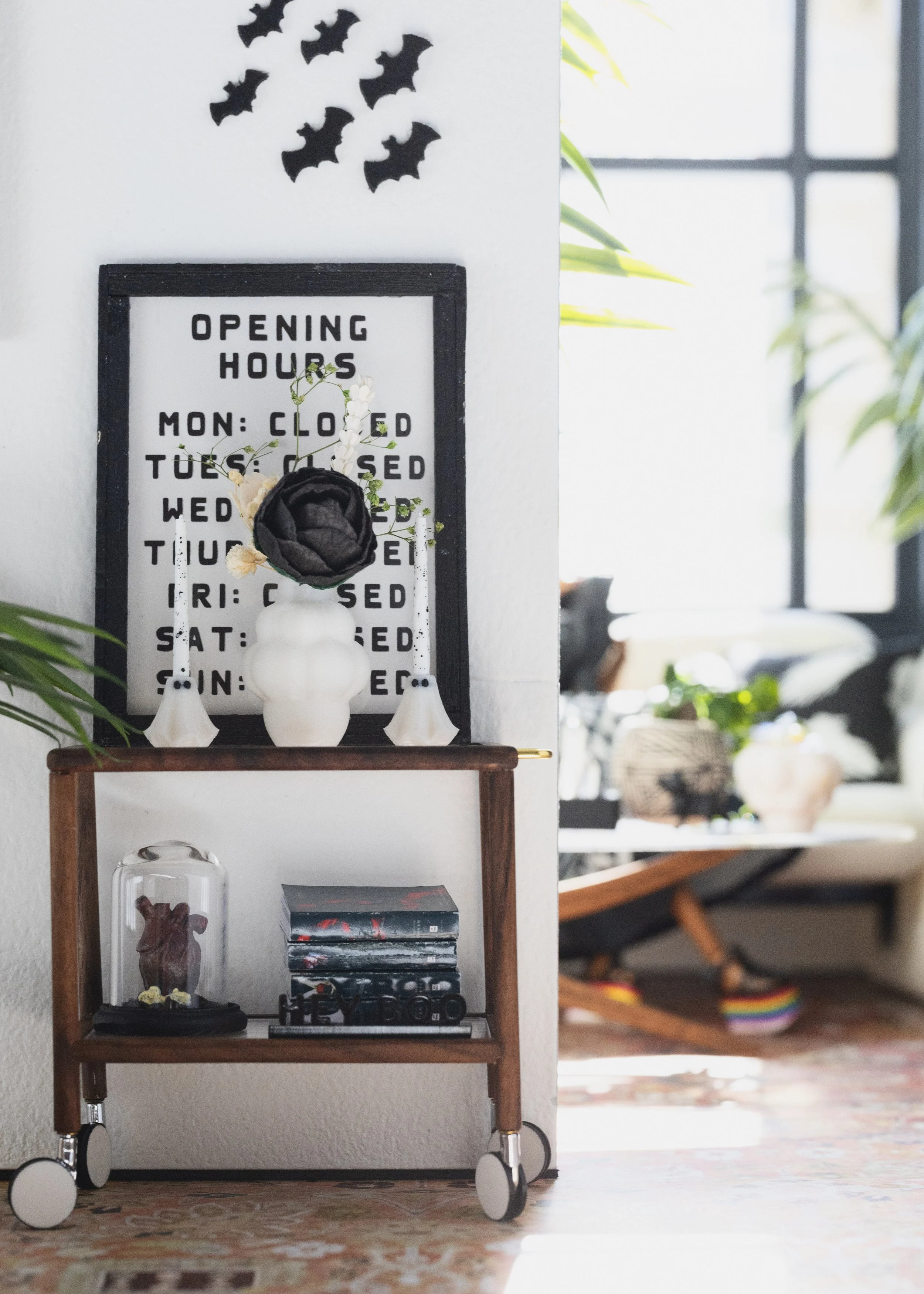
When I think about a modern Halloween home, I don't necessarily picture orange and black everywhere. I picture a home that already has its own personality, with a few seasonal pieces layered into it. Maybe there's a ghost on the coffee table, candlesticks on the dining table or there's a little bowl or vase that happens to look especially good in October but could easily stay out long after Halloween is over. That last part is important to me. I don't want to make pieces that only have one job.
One of the easiest ways to create a modern Halloween space is to start with what you already have. Don't begin by pulling out every Halloween piece. Start with the room.
What is the mood you want to convey?
Once you understand the space, you can introduce a few seasonal elements without losing the feeling of the home you've already created. For example, a neutral living room can take on a completely different mood with a white vase and dark flowers. A modern kitchen can feel seasonal with a Halloween-inspired plate or mug. A simple dining table can become a little more mysterious with candlesticks. Halloween pieces don't have to compete with the room. They can simply become part of it.
One thing I enjoy about creating miniature spaces is finding ways to tell a story without spelling everything out. I don't necessarily want the viewer to immediately see a scene and think, "Halloween!" I'd rather have them notice something first. Then notice the ghost, or the flowers and then realize, oh, this is a Halloween home. That little bit of discovery is what makes miniature storytelling so much fun for me.
Sometimes the seasonal object can simply be what it is. A ghost doesn't need to be surrounded by ten other Halloween decorations to tell us it's a ghost. Put one on a shelf, place another on a table and then give it some space. Let the room around it do some of the storytelling. I love it when a single unexpected object changes the feeling of an otherwise ordinary room.
That's one of the reasons I wanted the pieces in Hey Boo to work individually as well as together. You can build a whole Halloween space, or you can simply add one little reminder of the season to an existing diorama.
This is probably the most important part for me. I don't want my miniature homes to feel like sets that were decorated and then discarded. I want them to feel like someone just stepped out of the room. Maybe someone was making coffee, getting ready for friends to arrive, sitting on the sofa watching a scary movie, or there's a ghost just hanging around. Who knows? That's where your imagination gets to take over. Small details can help create that feeling. A chair that's slightly pulled out. A bowl left on the counter. A vase that's not perfectly centered. A few objects grouped together instead of perfectly spaced. Those little imperfections can make a miniature space feel much more believable.
I also wanted my Halloween pieces to have a life beyond Halloween. That's why I like objects that can be styled in different ways. A black vase isn't only a Halloween vase. A dark bowl isn't only a Halloween bowl. Candlesticks aren't only for October. And even something as recognizable as a ghost can become part of a larger story. Maybe the ghost stays on the shelf because, well, that's where they live now. I like the idea that seasonal pieces can become part of someone's miniature collection instead of being packed away for eleven months of the year.
Once everything is styled, this is where the story really comes together for me. I use natural light because I love what it does to a miniature space. The light doesn't just show you the objects. It helps establish the mood. For a Halloween scene, I might let the room become a little darker and moodier, using shadows to create depth. I'm not trying to make the scene look spooky just for the sake of being spooky. I'm trying to make it feel like a moment. Something happened before the photograph. Something might happen after it. The photograph is simply where we happen to find the scene.
If you're creating your own modern Halloween diorama, I'd start small. Choose one room, one color palette, or one seasonal focal point. Then add the everyday objects that make the room feel like home. You don't need a giant collection of Halloween miniatures. You don't need to fill every surface. And you don’t need everything to match. Start with the feeling you want. Maybe it's cozy. Maybe it's mysterious. Maybe it's playful. Maybe it's a little weird. Then build the room around that feeling.
A few questions to ask yourself:
What does Halloween feel like in this home?
What is the story happening outside of the frame?
Which object is the focal point?
Can I remove something instead of adding something?
Does this still feel like someone's home?
Those questions can take you much further than simply asking, "What Halloween decorations should I add?"
That's really what I keep coming back to with my miniature work. I'm not just interested in making miniature decor. I'm interested in home, memory, mood, and the little rituals that make a space feel personal. Halloween gives us another way to explore that. It can be dark and moody without being scary. It can be playful without being childish. It can be seasonal without feeling disposable and it can still look like home..
That's what I wanted Hey Boo to feel like, a little bit of Halloween brought into the everyday. Not a Halloween house.
Just a home with a little something extra.